The Story Behind the Dinner Jacket
The dinner jacket began as a less formal alternative to evening tails; its origins explain the lapels, dark cloth and restrained details that still define it.
The dinner jacket began as a less formal alternative to evening tails, and its original setting explains why it still looks so distinctive. To understand the dinner jacket’s history, look at the clothes it was designed to replace, the private rooms where it was worn and the details that made it suitable for dinner rather than ceremony.
What did the dinner jacket replace?
For formal evening occasions, a man’s established dress was the tailcoat: a dark coat cut short at the front and extended into tails behind. It belonged to a carefully ordered wardrobe, with different clothes for day and evening and clear expectations about when each should appear. The dinner jacket did not begin as a rejection of that system so much as a more relaxed option within it.
The distinction was one of setting. A tailcoat carried the formality of a public occasion; a shorter, easier coat suited a private dinner or an evening spent at home. The new garment kept a dark, tailored appearance while removing the conspicuous tails and some of the ceremony attached to them.
That origin helps explain why the dinner jacket is neither simply a dark suit nor a miniature version of a tailcoat. Its proportions and surface details signal evening dress. Wear it with ordinary business trousers and a plain daytime shirt, and those signals become less coherent, even if every piece is well made.
Why was it called a dinner jacket?
The name points to its social purpose: this was a jacket for dinner, particularly in settings where a tailcoat felt too formal. The garment’s appeal lay in its ease within a private room, not in a wish to dress casually in the modern sense. It was still carefully tailored and paired with clothes that marked the occasion as evening wear.
“Dinner jacket” is the usual British term. “Tuxedo” is widely used in North America for the same broad kind of black-tie ensemble, though local dress conventions and invitations can affect what is expected. The words describe a tradition as well as a garment, so it helps to read them in the context of the event rather than treat them as interchangeable labels in every circumstance.
Its early association with private evening life also explains the contrast between comfort and polish. A dinner jacket could feel less imposing than tails while remaining unmistakably formal. That balance is the garment’s central idea: reduced ceremony, not reduced attention to dress.
What do the lapels and buttons tell you?
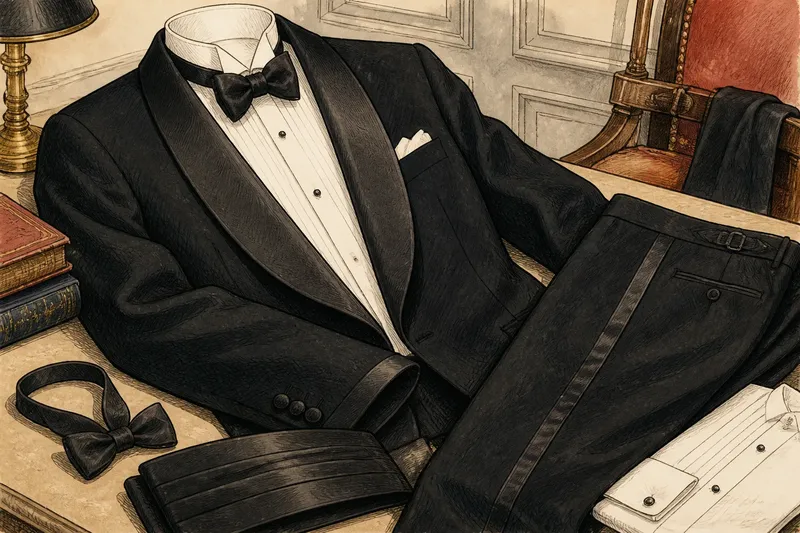
The lapel is one of the clearest clues that a jacket belongs to evening dress. A dinner jacket commonly has either a shawl collar, which forms a smooth curve around the neck, or peaked lapels with points that rise towards the shoulders. Both shapes frame the chest and create a more deliberate line than the notched lapel typical of many business suits.
Silk or another contrasting, lustrous fabric on the lapels makes that distinction visible. The sheen catches light differently from the jacket’s usually matte cloth and links the lapel to other evening details, such as the covered front of a dress shirt. It is not decoration added at random: it marks the garment as a special-occasion coat.
Buttons follow the same logic. They are often covered in matching or similar material, keeping the front visually quiet while echoing the lapel finish. A conspicuous metal button can shift the impression towards a uniform or club jacket, so the restrained treatment is part of the dinner jacket’s particular language.
These details are useful when assessing a second-hand jacket. Check whether the lapel facing and buttons look intentional and consistent, rather than assuming that any black jacket with a satin strip is proper evening dress. Construction, cut and the intended outfit matter together.
Why is the cloth usually dark?
Dark cloth gives evening dress a composed appearance under indoor lighting. Black became the familiar choice, while midnight blue offers a close alternative that can appear especially deep in artificial light. The point is not that every evening jacket must be identical, but that a dark, restrained surface keeps attention on the silhouette and the formal details.
Texture can vary without changing that basic character. A smooth wool cloth gives a clean outline; a subtle weave adds interest at close range without competing with the lapel. Strong patterns or casual surface treatments tend to make the jacket read less like traditional black tie, so consider the invitation and setting before choosing them.
The trousers are part of the same visual arrangement. Traditional evening trousers are made to accompany the jacket and commonly carry a satin or grosgrain braid along the outer seam. That narrow line relates to the lapel facing and helps distinguish the ensemble from a dark business suit. A pair of ordinary suit trousers may be close in colour but differ in cloth, finish and proportion.
How did the waistcoat and shirt complete the look?
The jacket was never meant to do all the work alone. A formal shirt, bow tie and appropriate waist covering help make the outfit read as evening dress, particularly when the jacket opens as its wearer moves or sits. The details are most convincing when they share a common level of formality instead of mixing black-tie pieces with everyday staples.
A waistcoat or a cummerbund can cover the waistband, though they are different options rather than pieces to wear together. A low-cut evening waistcoat shows the front of the shirt; a cummerbund wraps the waist and is worn with its pleats facing upwards. Either helps preserve an uninterrupted line beneath the jacket. The particular convention can vary, so follow the invitation and the ensemble’s intended design.
The bow tie is traditionally black and self-tied, but the useful point is proportion rather than tying a perfect bow. A very large tie can overwhelm a narrow lapel; one that is too small may look disconnected from the jacket. When choosing a set, compare the tie’s width with the lapel and the scale of your face in a mirror.
What should you look for in a dinner jacket?
Start with fit and coherence, not with an elaborate accessory. The jacket should sit cleanly across the shoulders, close without pulling at the front and allow comfortable movement. Its sleeves and body should work with the shirt and trousers you intend to wear, since a jacket that fits in isolation may look awkward as part of a full evening outfit.
- Check the lapel. Look for a shawl collar or peaked lapels and a facing that lies flat rather than puckering.
- Check the shoulders. The seam should sit close to the natural shoulder edge, without a hollow or a raised ridge.
- Check the front closure. Fasten the jacket and see whether it closes smoothly without pulling into diagonal creases.
- Check the trousers. Look for a formal finish that belongs with the jacket, including a side braid where the design calls for one.
- Check the shirt and tie together. The shirt should be appropriate for evening dress, and the bow tie should sit in scale with the lapels.
- Check the whole outfit in indoor light. Make sure the jacket, trousers and waist covering read as a coordinated ensemble rather than near-matching separates.
Say you have inherited a black jacket with glossy lapels but no matching trousers. Try it with a plain white evening shirt and dark trousers you already own, then inspect the outfit in a full-length mirror under the room lighting where you plan to wear it. If the trousers look like a separate business suit and the jacket’s proportions feel informal, a complete rental or a properly matched set may make more sense than buying decorative accessories to disguise the mismatch.
It is not worth chasing every historical detail for a single event. A spotless jacket with sound fit and compatible evening pieces matters more than obscure variations in button covering or an exact account of a garment’s early social circles. Read the dress code, then spend your attention on the parts people can actually see.
Which dinner jacket questions come up most often?
Is a dinner jacket the same as a tuxedo?
The terms usually refer to the same broad black-tie garment, with “dinner jacket” common in Britain and “tuxedo” common in North America. The accompanying dress conventions can differ by place and occasion, so use the invitation as your guide.
Can a dinner jacket be midnight blue?
Yes. Midnight blue is a traditional dark alternative to black and can look very deep indoors. Keep the trousers, lapel finish and accessories consistent with formal evening dress.
Can you wear a dinner jacket without a bow tie?
For conventional black tie, a black bow tie is the expected partner. An invitation that specifies a different dress code may allow another choice, but an open shirt collar changes the outfit’s formality rather than preserving the traditional look.
What is the difference between a dinner jacket and a suit jacket?
A dinner jacket is designed for evening dress, often with silk-faced lapels and matching formal trousers; a suit jacket belongs to a daytime or business suit and is made to coordinate with its matching trousers. Similar colour alone does not make the two interchangeable.
Why does the original setting still matter?
The dinner jacket’s history is practical: it was a less ceremonial coat for an evening meal, but it remained part of a carefully assembled dress code. That explains its dark cloth, distinctive lapels, restrained buttons and relationship to formal trousers and accessories. When you recognise those features as a connected system, the jacket becomes easier to choose and wear with intention.
For a dependable choice, think of the dinner jacket as the visible centre of an evening outfit rather than a standalone black coat. The original context still offers the simplest test: does each piece look at home at dinner, in the same room and under the same light?